
Home About Me Resume
CASE STUDY
CASPAR
Sustainable Business Design · Team project with CASPAR
My role
I synthesized the report’s current-state analysis, connecting CASPAR’s dependence on volunteers, missing executive sponsorship, and lack of impact measures. This made organizational readiness explicit in the research supporting our team’s phased growth recommendation.
A growth strategy grounded in organizational capacity
CASPAR is a volunteer-led network that helps Canadian universities make more environmentally and socially responsible purchasing decisions by sharing knowledge and practical tools. Our team worked with CASPAR on a growth strategy that its volunteers could realistically support. The case shows how research changed a promising business idea when the people expected to run it did not have the capacity.
CASPAR’s challenge changed as the team learned more about the organization. An initial focus on brand visibility expanded into revenue models, then returned to a more fundamental question: what could the organization credibly sustain? Through client conversations, workshops, ecosystem mapping, and organizational diagnosis, we developed a staged direction grounded in its existing knowledge and relationships. The decisive moment came when a business-model score conflicted with the organization’s capacity and values. That conflict changed the recommendation.
What this case covers
A growth strategy grounded in organizational capacity
Reframe the problem with the client
The brief moved from visibility to revenue, then toward a clearer independent identity and phased growth. Each reframing changed what a useful recommendation needed to accomplish.
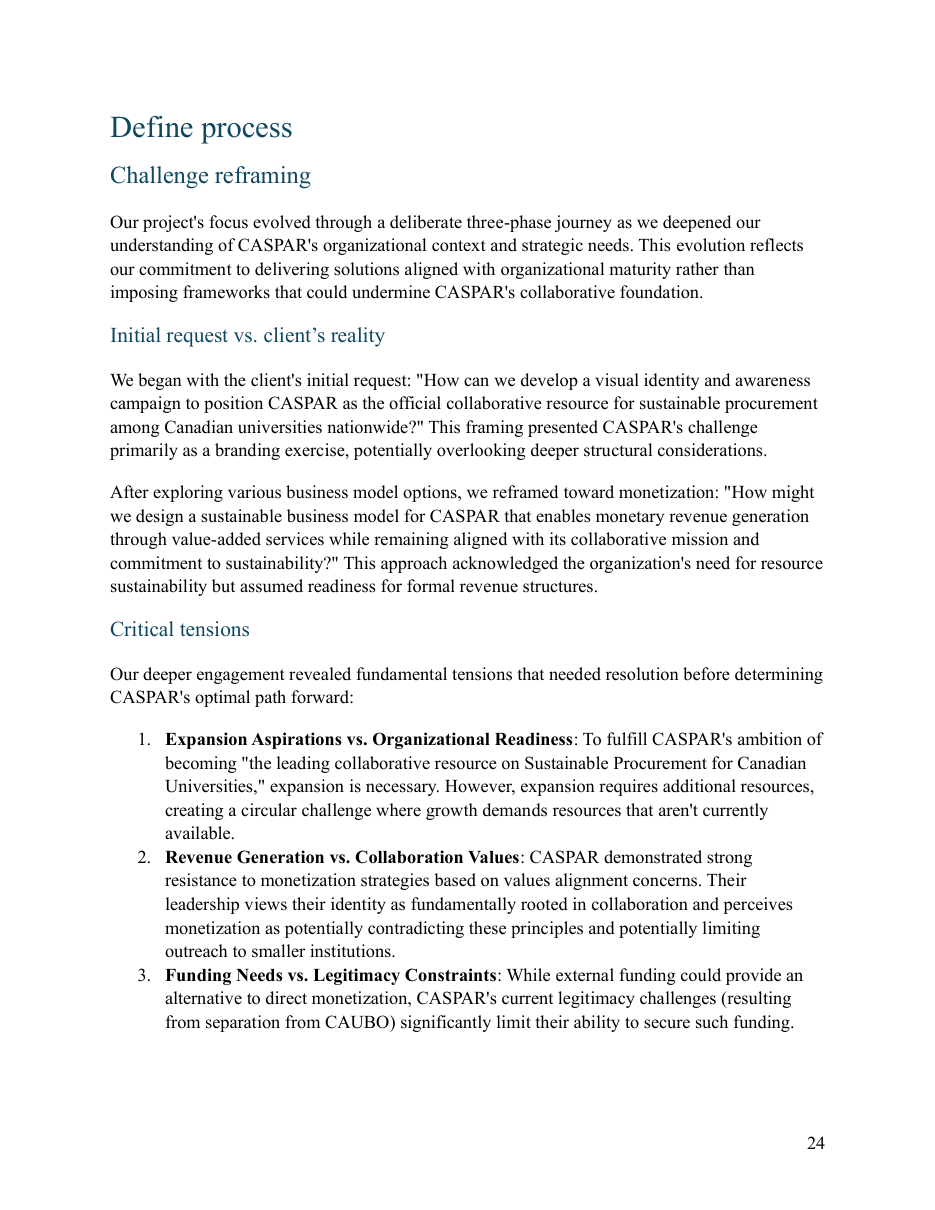
The team’s evolving challenge definition and three organizational tensions. Source: CASPAR final report, physical p. 25 (printed p. 24).

First view


Second view
Weekly client briefings kept the work connected to the organization between formal reviews. A Strategic Value & Identity workshop on May 29 explored what CASPAR stood for; a Visual Brand workshop on June 19 explored Institutional, Sustainable, Bold, and Creative directions. Affinity mapping identified five strategic patterns. The Viable System Model diagnosis highlighted weaknesses in identity and control functions. Together, these findings made organizational readiness part of the design problem, alongside communication and visual identity.
Source: CASPAR final report, physical pp. 6 and 25–26 (printed pp. 5 and 24–25).

Let capability challenge the score
Four models were compared: a Training Platform, Trash to Treasure, a Sustainable Business Directory, and an Automated Compliance Portal. The Training Platform received the lowest quantitative SWOT score, −0.15, yet capacity considerations changed the decision.
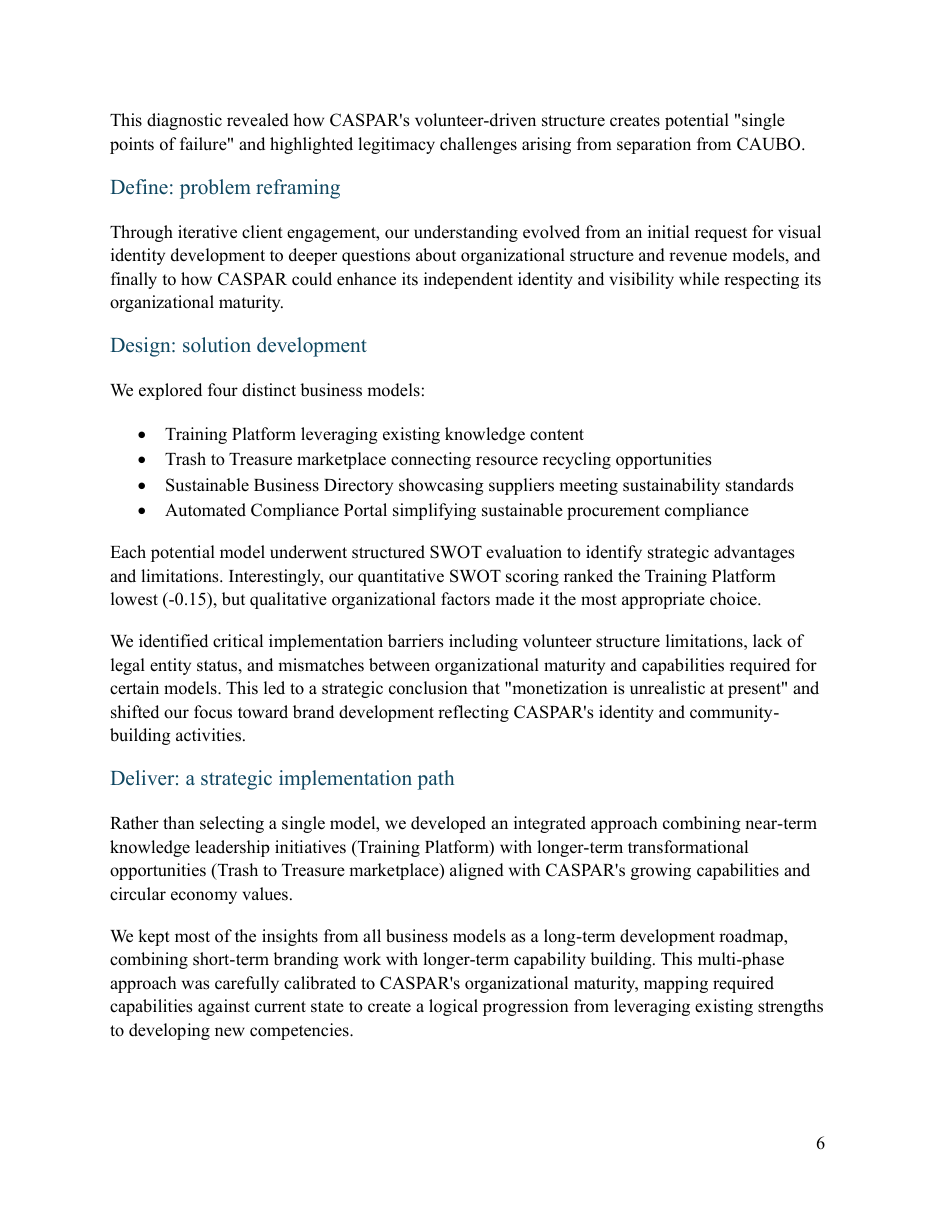
Four models and the capacity-based rationale for the team’s recommendation. Source: CASPAR final report, physical p. 7 (printed p. 6).
First view
Second view
A numerical comparison made the alternatives discussable, but could not settle the choice. CASPAR’s volunteer structure and organizational readiness constrained what could be operated reliably. The report concluded that monetization was unrealistic at that stage. This changed the purpose of the recommendation: build from existing knowledge strengths and a feasible sequence of development. The useful outcome of the scoring exercise was a visible tension to investigate, rather than a ranking to follow automatically.
Source: CASPAR final report, physical p. 7 (printed p. 6).
Define a role the organization can support
The client did not want sustainability knowledge to become an exclusive paid product. The proposed role emphasized connecting existing initiatives and sharing resources.
First view
Second view

This constraint also changed the meaning of Trash to Treasure. A future initiative could connect people to existing projects, templates, cases, and resources without making CASPAR responsible for inventory or transactions. That distinction matters operationally: an information and relationship role requires a different set of capabilities from running a marketplace. The actor and ecosystem analysis helped locate the organization among others who could contribute, rather than treating every promising activity as something CASPAR should own.
Source: CASPAR final report, physical pp. 17–20 and 31–32 (printed pp. 16–19 and 30–31).
Make growth conditional
The final deliverable proposed near-, medium-, and longer-term development, with evaluation measures tied to organizational readiness.
First view
Second view
The roadmap kept future possibilities visible. The case demonstrates how research can narrow a strategy until the responsibilities it creates are plausible for the organization that must carry them.
Source: CASPAR final report, physical pp. 34–37 (printed pp. 33–36).