
Home About Me Resume
CASE STUDY
Co-design: Workshop Iteration and Opportunity Areas
Workshop-method iteration and opportunity-area communication for an international-graduate employment study
My role
Co-design facilitation · Research synthesis
Change what participants can do
Our research explored the transition from university to employment for international graduates. In an early trial, participants mostly answered our questions. I wanted the next session to give them more room to respond to one another and shape the discussion.
I designed the opening activities and game-discussion section, facilitated alongside Harvey Li, and contributed to the research-paradigm and opportunity-area sections of the report.
This case follows the workshop redesign and the Opportunity Areas material I presented afterward.
Context: Innovative Research Methods, OCAD University
Format: Team research, 2024
My contribution: Opening activities, game discussion, facilitation and selected report sections
Evidence: Archived session guide, reflection and original Opportunity Areas presentation slides
What this case covers
I redesigned the opening and game-discussion activities after a trial, then helped turn the research into opportunity areas for our final presentation.
A trial that still felt like an interview
The first trial exposed a problem in our format: we had asked for participation, but structured the session around our questions.

First view


Second view

In my reflection, I described participants spending most of the trial answering us. I also noticed that trying to lead every turn made it harder for them to steer the discussion.
That changed the next design task. Rather than add more questions, we needed activities that gave participants something to choose, interpret and discuss with each other. Observing another group’s use of playful activities helped me see how a different format could work.
Give participants something to respond to
I designed the opening and game-discussion sections around prompt-card choices and awkward-networking scenarios. Harvey developed the mentorship discussion.
First view
Second view
The archived guide starts with a prompt-card icebreaker: choose a response to a networking situation, then explain the choice. In the scenario activity, another participant can add a different response. This creates a starting point for discussion without requiring a single correct answer.
The guide also explores an imagined networking self and choices about how to spend time with mentors, employers and peers.
Carry the reflection into possible next steps
The second session gave participants more space to contribute, but the opening activities took longer than planned. We cut one activity rather than force the original schedule.
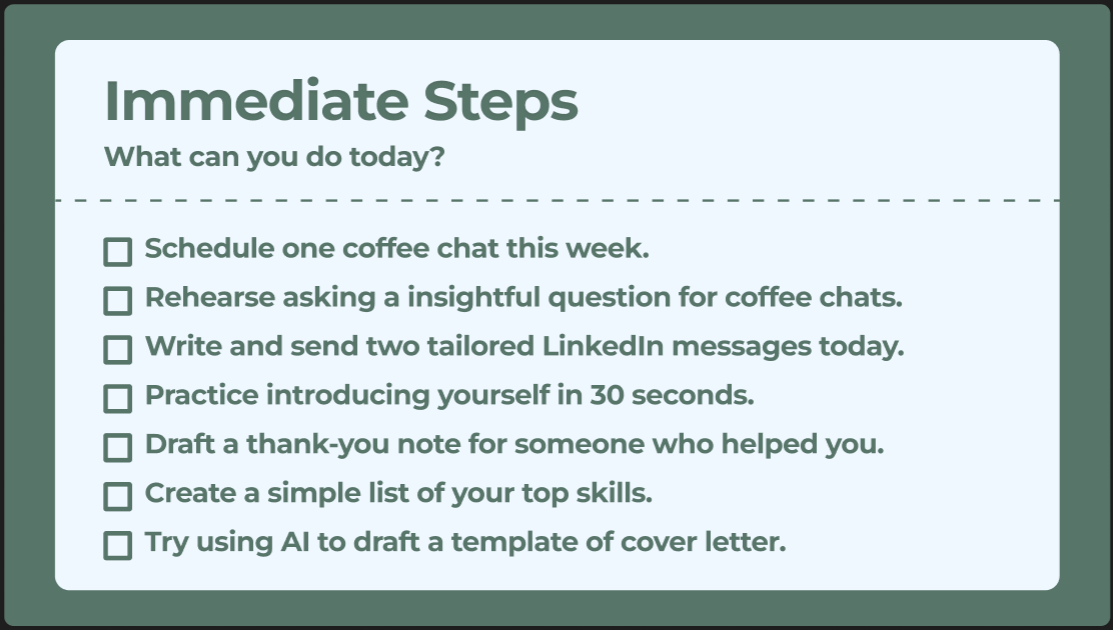
The original presentation turned proposed opportunity areas into a short checklist for its audience.
First view
Second view
My reflection records a more participatory second session and my counter-questions encouraging deeper contributions. It also records a timing problem: the games overran, so one planned activity had to be removed.
Afterward, Harvey and I worked on the synthesis. My report responsibilities were the research-paradigm and opportunity-area sections. I used the reflection to examine how our own experience as international students shaped the research and how to present possible next steps.
The useful lesson was to design both the activity and the room it leaves for participants. A script can help a session begin; it cannot account for everything that happens once people start contributing.
In the final presentation, I translated the proposed opportunity areas into a short set of possible actions for the audience. The accompanying “Immediate Steps” slide records that communication choice.