
Home About Me Resume
CASE STUDY
Consumer Ethics: From stakeholders to leverage points
Stakeholder mapping and intervention framing in a collaborative systems-design project
My role
Systems mapping · Stakeholder analysis · Strategic design
Who could change the system?
Our team examined consumer ethics in social media, focusing on the relationships between purchasing, online trends and sustainability claims. The challenge was to make that system useful for a discussion about change.
I was responsible for the Actants Map, Influence Map and Leverage Points work. I also helped the team define its boundaries and develop the inquiry through shared mapping.
Synthesis Map: the team follows Bee, a consumer, from today’s consumption system through a coordinated transition to a lower-impact future. The map connects visible feedback loops to cultural myths, with repair cafés, second-hand commerce and under-consumption as seeds of change.
The causal loop analysis links climate anxiety to demand for green products, which can encourage genuine sustainability or greenwashing that only offers temporary reassurance. The proposed future adds delays between trend exposure, desire, production and purchase to support verification and deliberate choices.
Map Brief: the team translates leverage points into proposals addressing greenwashing incentives, algorithm-driven trend cycles and transparency at checkout. Its sequence moves from claims standards and transparency frameworks toward algorithm changes, checkout information and cultural shifts, while considering jobs, affordability and corporate workarounds.
Context: Systems Thinking, OCAD University, Winter 2025
Format: Collaborative project
Outputs: System Mapping Dossier and presentation
My scope: Actants Map, Influence Map, Leverage Points; shared boundary judgement and iterative inquiry
Status: Analytical maps and proposed interventions
What this case covers
I mapped actors and stakeholder influence, then connected them to intervention options for a project on consumer ethics in social media.
Set a boundary before choosing a solution
We needed to decide which relationships belonged in the inquiry before proposing ways to change consumption.
Synthesis Map: the team followed Bee, a consumer, through three horizons: today’s consumption system, a transition shaped by coordinated stakeholder action, and a desired lower-impact future. Trees connect visible feedback loops to the cultural myths that sustain them. Repair cafés, second-hand commerce and under-consumption appear as seeds of change.
The causal loop analysis connects climate anxiety to demand for green products. That demand can support genuine sustainability or greenwashing that offers temporary reassurance without resolving environmental harm. The proposed future introduces delays between trend exposure, desire, production and purchase, creating time for verification and deliberate choices.
Map Brief: the team translated those leverage points into three intervention areas: greenwashing incentives, algorithm-driven trend cycles, and transparency at checkout. Its proposed sequence moves from claims standards and transparency frameworks to algorithm changes, checkout information and incentives, then to cultural shifts in consumption. The brief also examines job impacts, affordability barriers and corporate workarounds. The original map, enlarged loops and implementation excerpt follow below.

First view


Second view

I joined the shared boundary-judgement and iterative-inquiry work. The project brought consumers, platforms, brands, information and policy into the same discussion.
Full team project documents — original PDFs
Systems dossier (PDF, 25 pages)
These are collaborative project documents. Individual contributions are described in the case text; the complete documents retain their original team credits.
Connect actors to their influence
I was responsible for the Actants Map and Influence Map. The Influence Map compares stakeholder power and interest to help us ask who could act on a proposed change.
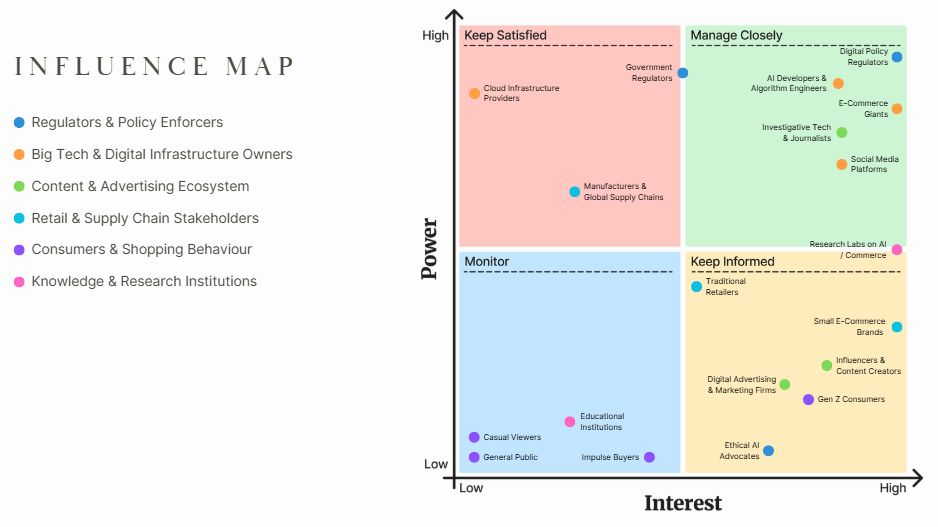
Original Influence Map from the team’s systems dossier. Power runs vertically and Interest horizontally.
First view
Second view
The vertical axis represents Power and the horizontal axis Interest. Four quadrants distinguish groups to manage closely, keep satisfied, keep informed or monitor. My presentation focused on digital policy regulators, AI and algorithm developers, e-commerce companies, and social media platforms. I explained their different roles in rules, recommendation systems, markets and visibility.
These distinctions gave the intervention discussion specific actors to consider. The map records the team’s analytical judgements.
Move from the map to possible interventions
I worked on the Leverage Points section, connecting the team’s system analysis to possible changes and the actors involved.
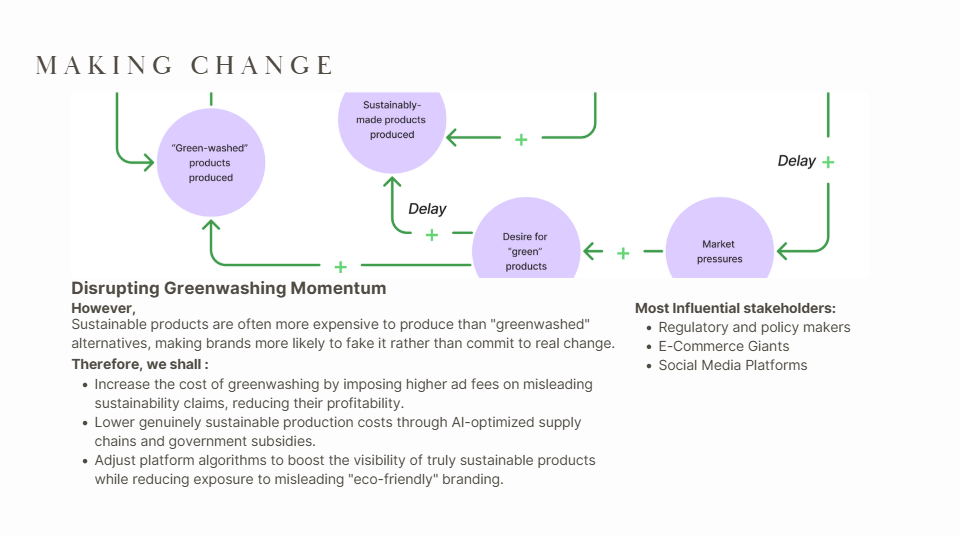
Original Making Change slide: a causal-loop excerpt links the greenwashing discussion to proposed incentives and responsible actors.
First view
Second view
We grouped the discussion around greenwashing incentives, algorithm-driven trend cycles, and transparency at purchase. The proposals included changing the incentives around misleading claims, introducing delays in trend amplification, and making sustainability information more visible at checkout.
I used the influence work to explain which organisations could be involved. The causal-loop work was part of the team’s analysis; the source archive credits Hannah’s loop.
Make the case for change understandable
Feedback on the dossier asked us to add a story and spend more time on how change might happen.
First view
Second view
The feedback exposed a presentation gap: much of our effort had explained the system, while the audience still needed a clear account of what could change.
The work continued into a synthesis map. This first view focuses on stakeholder influence and intervention framing; the second view follows the assumptions and risks that a proposed transition would need to address.
Synthesis Map: three horizons for change
The team translated the systems analysis into a landscape that follows Bee, a consumer, from the current system through a transition zone toward a desired future. The Three Horizons framework separates what sustains today’s behaviour, the coordinated changes needed in between, and the conditions we hoped to enable.
Trees connect visible feedback loops to the cultural myths at their roots. Repair cafés, second-hand commerce and under-consumption appear as existing seeds of change.

Team synthesis map, complete composition. Read the enlarged causal-loop excerpts below.
First view
Second view
Causal loop analysis: make the change in feedback visible
The current-state loop connects climate anxiety, demand for green products and market pressure. The team’s analysis shows two possible supply responses: genuinely sustainable goods and greenwashed goods that relieve anxiety while leaving environmental harm unresolved.
The desired-state loop inserts delays between trends, purchase desire, production and buying. The design intention is to make room for verification and deliberate choices rather than another rapid purchasing cycle.

Current system: relief without resolution
Enlarged original map excerpt. Greenwashed purchases can lower anxiety without addressing the underlying environmental problem.

Desired system: introduce time to reconsider
Enlarged original map excerpt. Delays separate trend exposure, desire and purchase, alongside a slower pathway for low-footprint production.
Map Brief: turn leverage points into a sequence
The brief develops three proposed intervention areas: change the incentives behind greenwashing, slow algorithm-driven trend cycles, and make sustainability information visible at purchase. Examples include checking misleading claims, content cooling periods and sustainability data at checkout.
It then sequences the work. Foundation building establishes claims standards and transparency frameworks while influencers shift the narrative. System transformation introduces algorithm changes, checkout information and incentives. Culture shift focuses on sustainable choices and new consumption norms.

Original brief excerpt: proposed implementation phases, page 16.
First view
Second view
Account for the side effects of a slower system
The brief does not treat slower consumption as an uncomplicated win. It identifies risks to jobs and supply chains, unequal access to sustainable products, performative environmentalism, corporate workarounds and more sophisticated greenwashing.
Its proposed safeguards include worker-transition planning, more accessible pricing, standards that distinguish action from performance, multi-stakeholder governance and continuous monitoring. Those dependencies are part of the design problem: an intervention needs a responsible actor, an incentive to sustain it and a way to detect unintended effects.
First view
Second view