
Home About Me Resume
CASE STUDY
Intergenerational Design Toolkit
Collaborative research project · Research translation and toolkit design · OCAD University · 2026
My role
Research synthesis · Toolkit co-development · Decision-tool design
Turn findings into decisions people can use
Harvey Li and I developed a toolkit for designers, facilitators and community coordinators. We translated our shared research into tools for choosing an approach, preparing a session and deciding what to revise.
This case follows three parts of that translation: question-led navigation, a pairing decision tree, and an observation sheet that connects behavior to possible design responses.
My contribution: Shared research framing, analysis and toolkit development with Harvey Li
Output: Eight-module Intergenerational Design Toolkit, published in 2026
What this case covers
I co-developed a toolkit that turns intergenerational-play research into decisions about pairing, facilitation and design revision.
Start with the decision someone needs to make
We organized the toolkit around practical questions for designers, facilitators and community coordinators.
Our research produced design principles, but a facilitator still needed to know what to do next. We made the entry point a question: who to design for, how to pair people, which interaction to choose, or what to change after a session.
Each route names the relevant module and the tool the reader will get. Someone working on pairing can go straight to a decision tree and checklist.
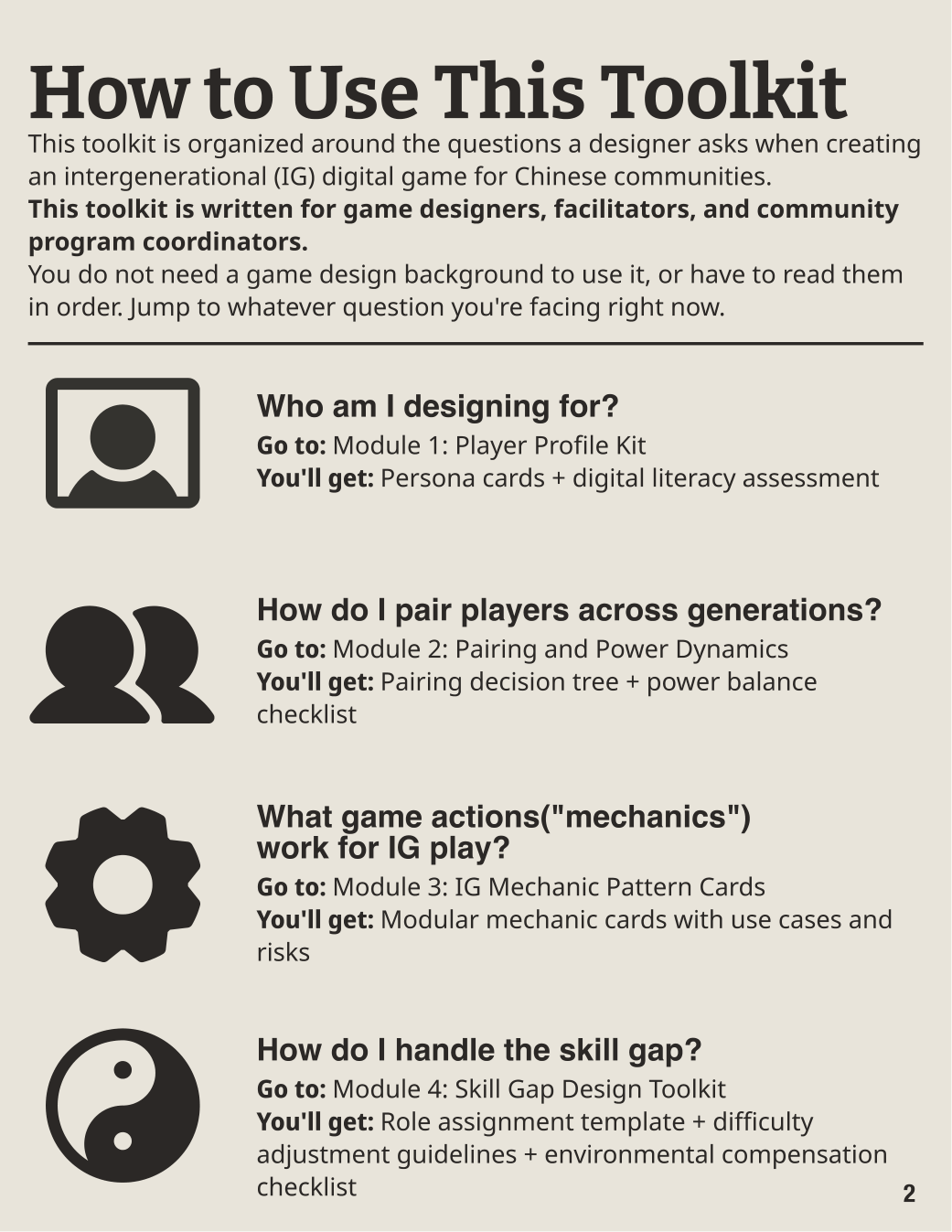
Question-led navigation in the published toolkit, PDF page 3, printed page 2.
We organized the toolkit around practical questions for designers, facilitators and community coordinators.
We organized the toolkit around practical questions for designers, facilitators and community coordinators.

First view


Second view

We organized the toolkit around practical questions for designers, facilitators and community coordinators.
The eight modules cover participant fit, pairing, game interactions, skill differences, accessibility, cultural framing, evaluation and community coordination. The same format introduces each route: a question, a destination and a concrete output.
This connects the report’s findings to work at different moments in a session. The reader can enter where a decision is needed rather than read the research from beginning to end.
Turn pairing concerns into a decision path
The research showed that being present together does not guarantee that both people can contribute.
We translated concerns about communication and role imbalance into a pairing decision tree. For community strangers, the tree checks shared language, communication fit and the availability of a bilingual facilitator.
It gives different next steps for different conditions: proceed with an icebreaker, add support, change the interaction, or regroup.
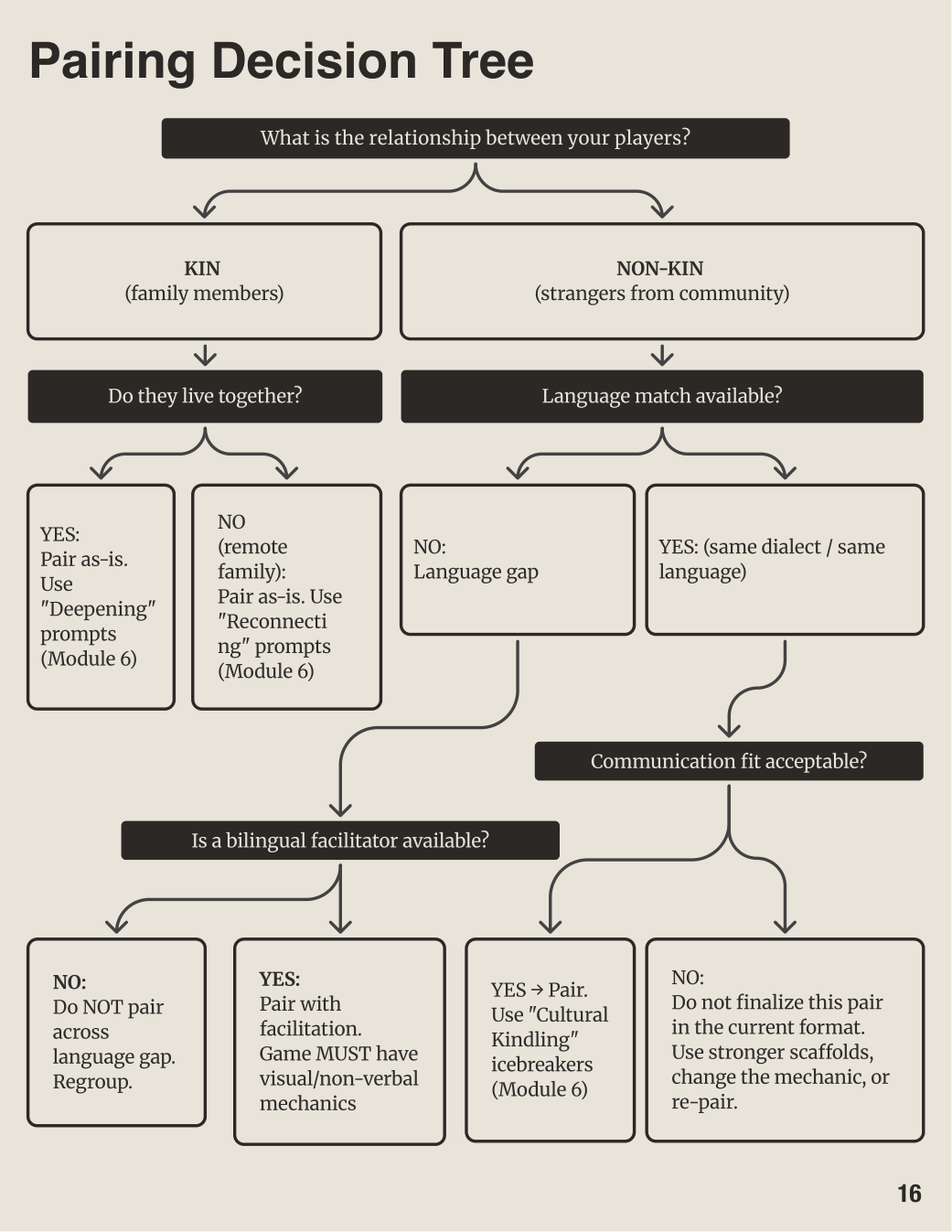
The pairing decision tree, PDF page 17, printed page 16. It distinguishes family pairs from community strangers and includes routes for communication support.
The research showed that being present together does not guarantee that both people can contribute.
The research showed that being present together does not guarantee that both people can contribute.
First view
Second view
The research showed that being present together does not guarantee that both people can contribute.
Our consultation findings described situations where one person operated the game while the other watched, and where younger participants carried most of the explanation. The broader synthesis also identified language fit and power balance as design concerns.
The tree makes these concerns actionable before play starts. Even when two people share a language, it asks whether the communication fit is workable. A separate power-balance checklist then asks whether both players have an essential contribution and whether one person has become the default teacher.
Open the pairing decision tree
Open the accompanying power-balance checklist
Connect observations to the next revision
We paired observable signals with possible design responses so the evaluation could inform the next session.
The Observation and Response Sheet links what a facilitator notices to something the design team can reconsider. Repeated reliance on a facilitator points toward onboarding, role design or interface clarity. Technical friction points toward the input demand or platform setup.
The sheet asks observers to look for repeated or clustered patterns before changing the design.
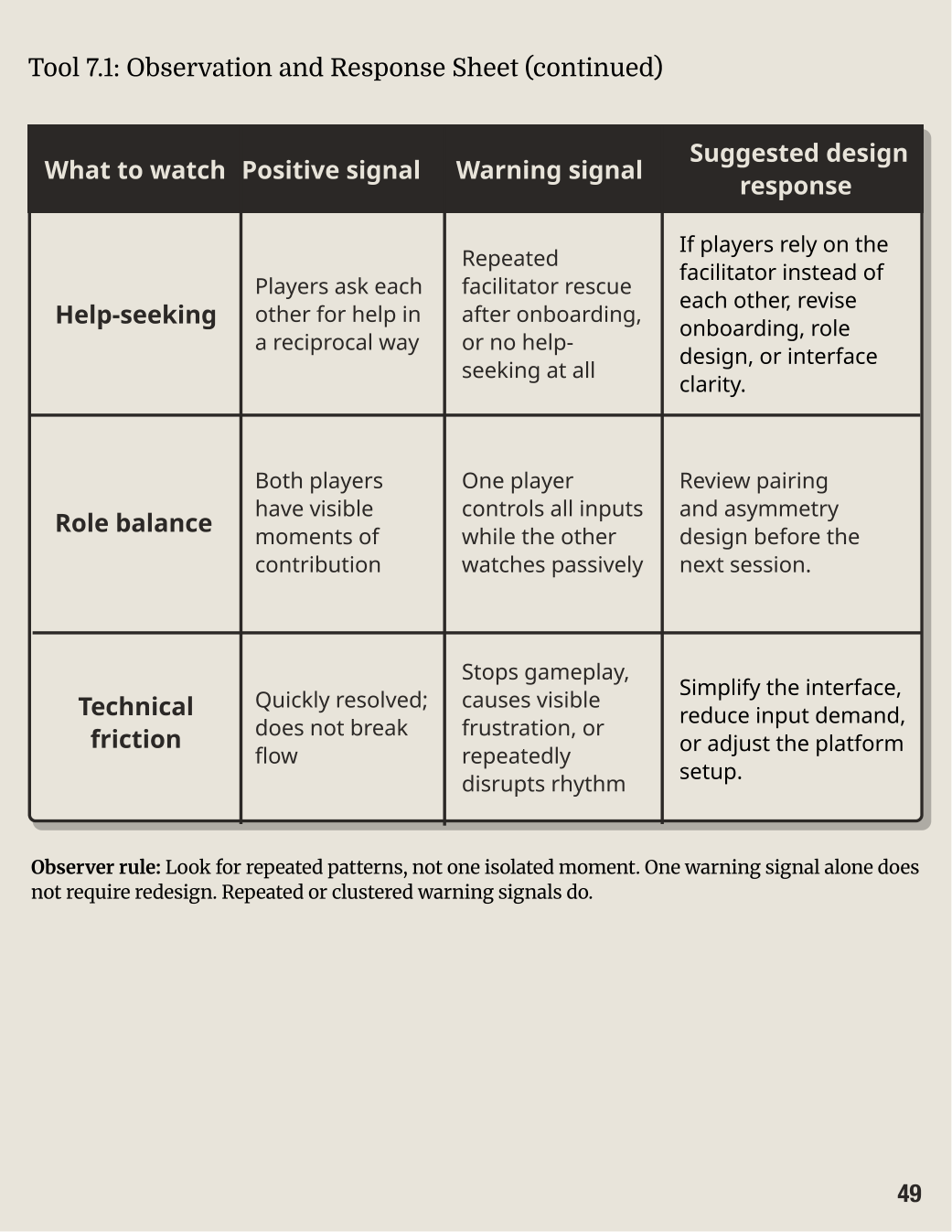
Continuation of the Observation and Response Sheet, PDF page 50, printed page 49. The columns connect interaction signals with suggested next actions.
We paired observable signals with possible design responses so the evaluation could inform the next session.
We paired observable signals with possible design responses so the evaluation could inform the next session.
First view
Second view
We paired observable signals with possible design responses so the evaluation could inform the next session.
The research distinguished unfamiliarity with the game from a deeper problem with its mechanics. It also showed that unclear prompts could make a younger player carry the teaching role. Those findings informed a response tool that keeps the observed behavior and the possible design change alongside each other.
For example, silence accompanied by confusion suggests a different response from silence accompanied by one person dominating. The first may call for clearer onboarding; the second may call for different roles or pairing. This keeps an observation connected to its context.
Open the observation and response sheet
Open the continuation shown here
Read the onboarding and role findings