
Home About Me Resume
CASE STUDY
NETFLIX
2025 · Strategy articulation and development
My role
I scripted and presented the opening of both team presentations: Netflix's business model, strategy and capabilities, then the burning platform and vision behind our proposal. For the final deck I built the capability timeline and Strategy Cascade, simplified the initiative timeline and updated our initiative scoring scale. Co-authored with Markhan Hussain, Roberto Pires and Zhidong Chen.
From strategic tensions to a sequenced innovation proposal
Daily Netflix viewing per account fell from 2 hr 1 min in 2023 to 1 hr 46 min in late 2024. Across two linked Winter 2025 strategy reports, our four-person team diagnosed Netflix's current strategy and built a 10-year innovation proposal: 32 candidate initiatives screened with MUST and weighted WANT criteria, sequenced on a timeline and tied to the capabilities and OKRs needed to deliver them.
What this case covers
From strategic tensions to a sequenced innovation proposal
Make the strategic tension explicit
I opened our final presentation with this burning platform. Falling daily viewing, read alongside the attention-disruption argument from our articulation report, meant Netflix needed deeper participation and repeat engagement, beyond adding more long-form titles. So every initiative had to carry an engagement rationale and fit Netflix's existing content, personalization and distribution capabilities.

First view


Second view

Growth, revenue, content investment and audience attention were treated as connected strategic questions. An idea that looked attractive in one area still had to make sense against the wider diagnosis. The articulation report became the reference for every later choice: what pressure does an initiative address, and how does it fit the business?
Source: NETFLIX strategy articulation report, pp. 17 and 19; strategy-building report, p. 3.
Screen first, then weigh the trade-off
We screened initiatives in two passes: MUST criteria (strategic alignment, fit with core capabilities, market potential) removed options that did not qualify, and the rest were scored on eight weighted WANT criteria. Our team rated Merch Suggestion with kickbacks ahead of the Storyworld Simulation Engine on feasibility and time to revenue, and behind it on audience engagement. On our timeline, merchandise suggestions start in 2025 and the more complex story-building work comes later.
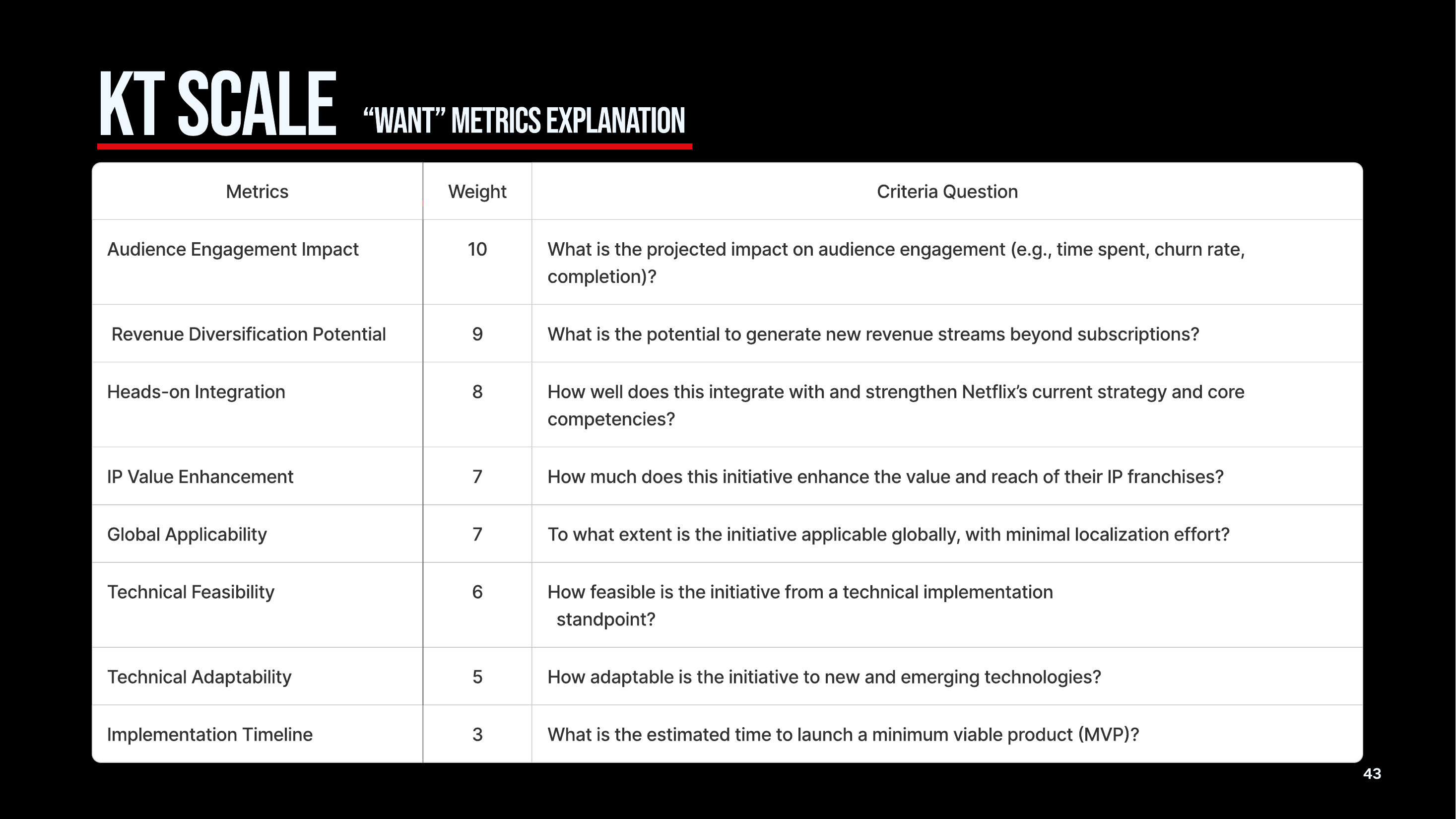
Our eight WANT criteria, with weights and guiding questions. Strategy-building report, p. 43.
First view
Second view
The two passes did different jobs. The MUST gateway decided whether an option belonged in the consideration set. The weighted WANT criteria then compared the options that cleared it, so the reason behind each selection can be inspected. The final report sets out the eight WANT criteria with their guiding questions, followed by a Kepner-Tregoe scoring graphic.
Our team's ratings, Merch Suggestion with kickbacks vs Storyworld Simulation Engine: technical feasibility 9 vs 7, time to revenue 8 vs 3, audience engagement 6 vs 8. On the timeline, merchandise suggestions come in 2025, pop-up promotions in 2026, and the more complex story-building work follows.
Source: NETFLIX strategy-building report, pp. 14, 20, 43 and 44.

Link initiatives to enabling capabilities
We tied each initiative to the capability that makes it possible. Our Strategy Cascade links merchandise to merchandising and loyalty integration, and our capability timeline starts merchandise engagement in the 2025 community-engagement phase. Story-building needs creator tools, rights infrastructure and immersive storytelling, so it comes later in the plan.
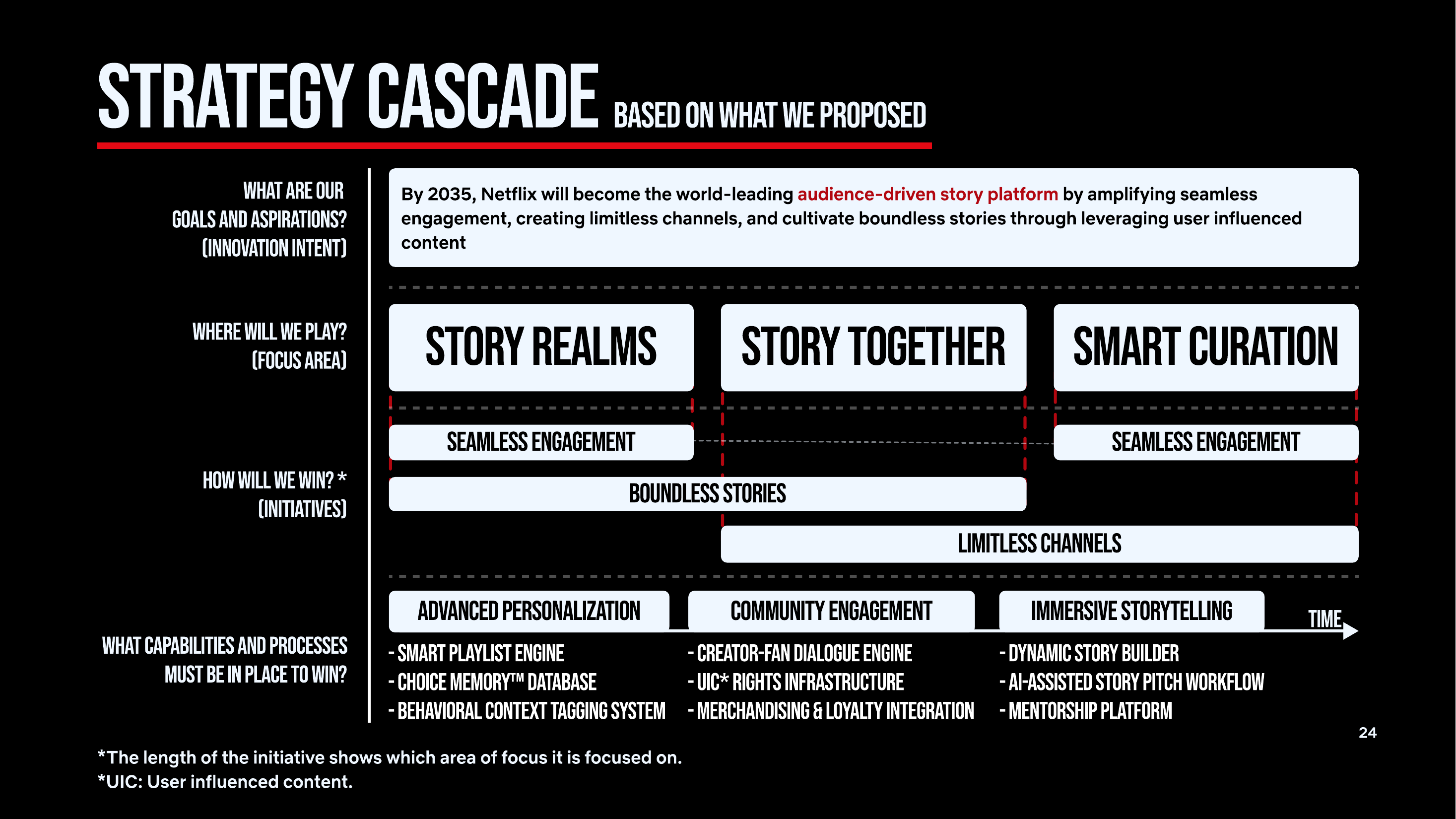
The Strategy Cascade I built for our final deck, linking aspirations, focus areas, initiatives and enabling capabilities. Strategy-building report, p. 24.
First view
Second view
Sequencing answers three practical questions: what comes first, which capabilities must be in place, and how progress is measured. The initiative and capability timelines run side by side, so each initiative can be traced to the capabilities it depends on, and the cascade places both within the wider strategic direction. The story-building path: an internal video LLM in 2027, the Dynamic Story Builder in 2029 and a public launch in 2034.
Our Community Engagement key result is 1% of annual revenue from merchandising by 2029, and I prepared the reasoning for why we chose our key results. Our WANT criteria score engagement through time spent, churn and completion.
Source: NETFLIX strategy-building report, pp. 20, 22 to 24, 43 and 44.
Improve the legibility of the reasoning
The process record includes 32 candidate initiatives and completed tasks to simplify timeline language, add a non-color legend, update the evaluation scale, and prepare an appendix for numerical derivations.
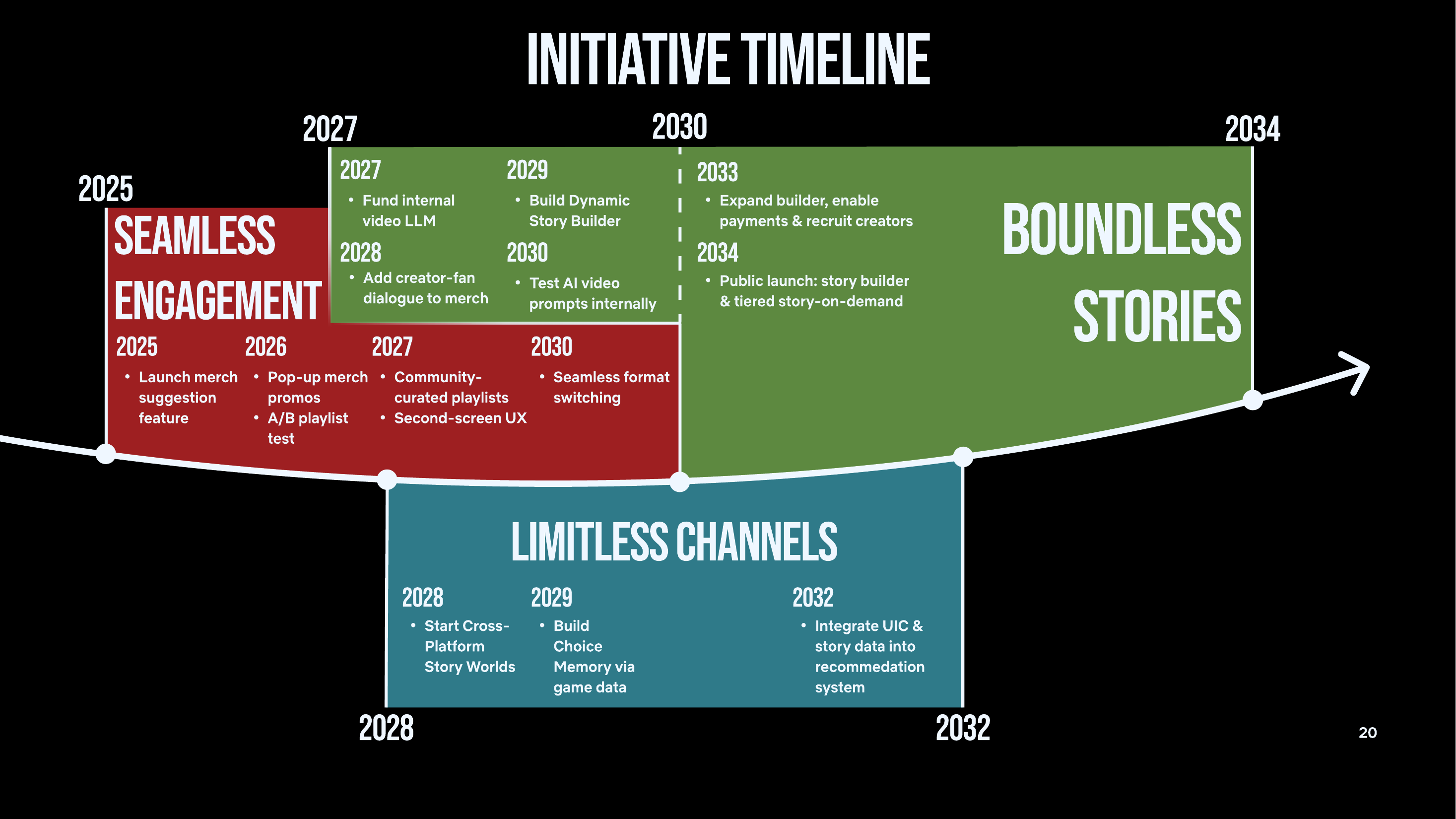
Our initiative timeline, with named streams and dated activities. Strategy-building report, p. 20.
First view
Second view
I simplified the initiative timeline's wording and gave it a legend that does not rely on color alone, so readers can tell the activities apart. An appendix traces the key numbers back to their assumptions. For the final deck I also built the capability timeline and the Strategy Cascade.
Source: project task list; NETFLIX strategy-building report, pp. 20, 22 to 24 and 43.