
Home About Me Resume
CASE STUDY
PANGAIA
Independent business-model case analysis
My role
I authored the recommendation on PANGAIA’s Super Super Bar, connecting the business-model analysis to a decision about the product’s role.
Testing the case for scaling Super Super Bar
Should a sustainable clothing brand scale a snack bar into a new business? This work pairs a spreadsheet model with a one-page recommendation. The process moves from research and market assumptions to lower and upper revenue scenarios, then tests the opportunity against operational fit and environmental assumptions. My recommendation was to keep Super Super Bar as a limited offering supporting the brand’s environmental story.
What this case covers
Testing the case for scaling Super Super Bar
Build the model from assumptions
The spreadsheet starts with a US$53.33bn market input (G4), applies 15% and 20% sustainable-share assumptions (G5:G6), then averages the two results to US$9.33275bn (G9). Lower and upper capture-rate scenarios feed revenue estimates. The research notes distinguish the total snack market from healthy, organic and sustainability-marketed segments. Open the full-size workbook excerpt to inspect the original inputs and source links.

Workbook excerpt, Pangaia Analysis A1:X17, rendered directly from the original spreadsheet. Assumptions: US$53.33bn total market in G4 and US$9.33275bn sustainable-market midpoint in G9.

First view


Second view

In the Pangaia Analysis sheet, G7 multiplies the market input in G4 by the lower share in G5; G8 applies the upper share in G6. G9 averages those two results. Later rows distinguish lower, upper, and midpoint revenue estimates before calculating profit and cumulative profit. This structure makes the source of a scenario legible.
Signed recommendation by Yang Yi. Source: PANGAIA business-model workbook, Pangaia Analysis, G4:G9 and D24:L30.
Compare scenarios before recommending scale
Lower and upper market-share paths feed revenue estimates, then profit and cumulative profit. The written outline weighs those projections against food-sector capabilities: product development, safety compliance, ingredient supply and retail distribution. A large modeled opportunity alone does not settle whether the business is a good fit.

Workbook excerpt, Pangaia Analysis A20:T30, rendered directly from the original spreadsheet.
First view
Second view
Cell D50 uses the PV function with inputs D45:D49.
Signed recommendation by Yang Yi. Source: PANGAIA business-model workbook, Pangaia Analysis, D45:D50; PANGAIA recommendation, p. 1.
Trace the environmental assumptions
The model follows two environmental paths. Ingredient water-footprint values feed an average and a comparison; cumulative revenue feeds estimated bar sales, then a packaging calculation. Keeping those dependencies visible shows which assumptions drive the environmental story.

Workbook excerpt, Pangaia Analysis A54:P74, rendered directly from the original spreadsheet. Packaging totals are cumulative five-year scenario estimates.
First view
Second view
D66 averages six ingredient water-footprint values without weighting them by recipe mass. J61 totals five years of modeled revenue, J62 converts that total to estimated unit sales, and J63 derives a cumulative plastic-avoidance estimate. The case keeps these dependencies visible so that the environmental narrative can be examined with the same care as the commercial assumptions.
Signed recommendation by Yang Yi. Source: PANGAIA business-model workbook, Pangaia Analysis, D66, D73, and J61:J63.
Turn the analysis into a recommendation
The working outline brings together economics, operational fit and brand value. The final one-page recommendation keeps the bar as a limited-edition brand initiative instead of a large-scale expansion. The signed document below shows how those strands became a concrete recommendation.
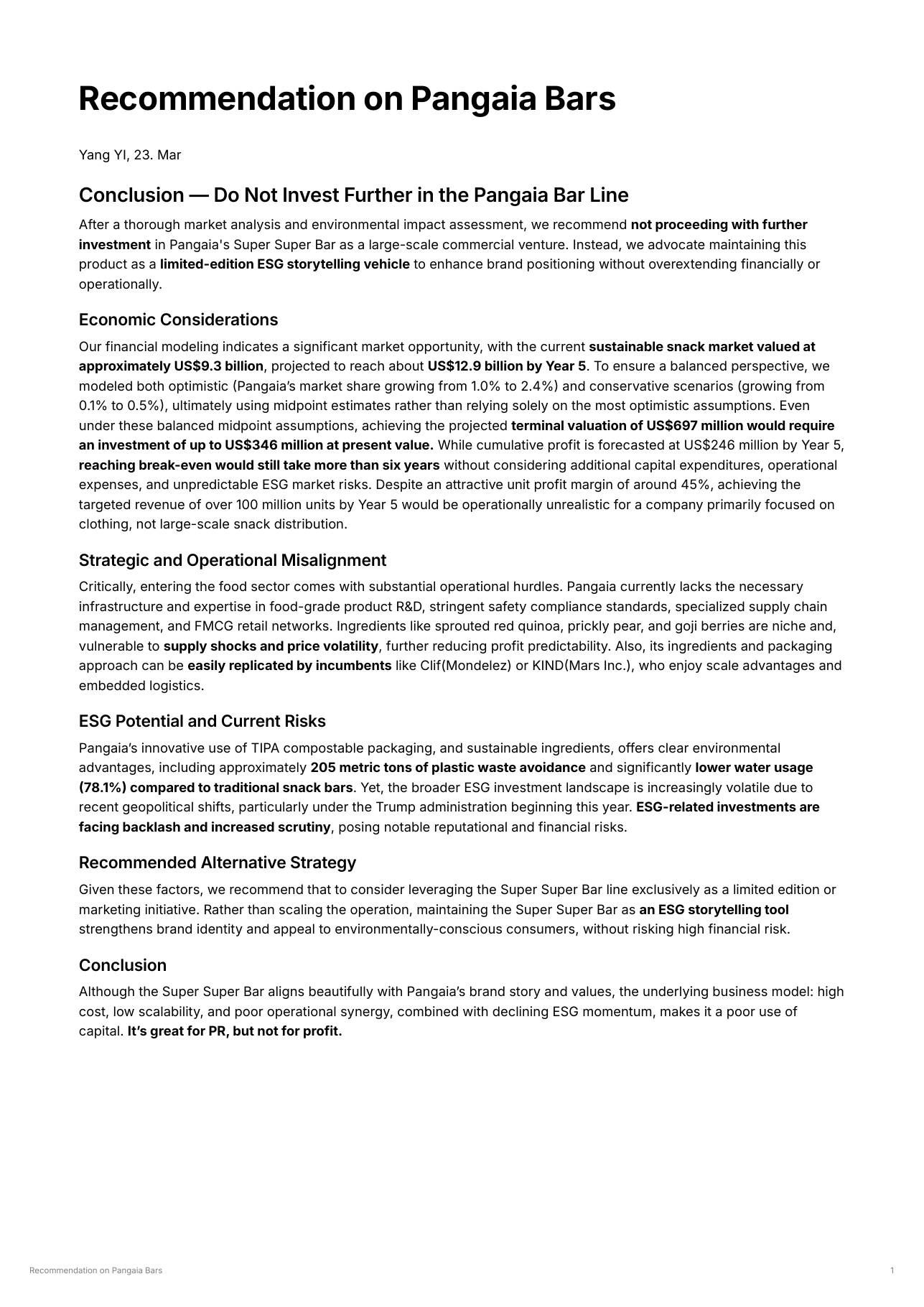
Recommendation by Yang Yi, 23 March.
First view
Second view
That decision gives the modeling a clear strategic purpose: assess the case for expansion rather than treat a projected revenue figure as an instruction to grow. The one-page format connects the analysis to a choice about the product’s role.
Signed recommendation by Yang Yi. Source: PANGAIA recommendation, physical p. 1, signed Yang YI, dated 23 Mar.