
Home About Me Resume
CASE STUDY
Whose Art Is It Anyway?
Physical drawing-and-voting game · Rules and cards · 1 day
My role
Solo game design · Rules, cards and vote flow
Project at a glance
I used MDA to analyze The Beginner's Guide, then turned its conflict over who owns an artwork's meaning into a paper game for a Creator, an Interpreter and an Audience. I replaced the score with two votes that branch into four endings.
Role: Solo game designer (rules, cards, vote flow, MDA analysis, in-class run, post-mortem)
Format: Physical drawing-and-voting game with printed cards, paper, black and red markers and a timer
Players: 1 Creator, 1 Interpreter and an Audience
Round length: 8 to 10 minutes
Context: DIGF-6018, Digital Games, OCAD University · January 2025 · Built in 1 day
What this case covers
My solo paper game turns The Beginner's Guide's question of who owns an artwork's meaning into a drawing game with a possibly misleading Interpreter and two votes.
I cut the score
My first version scored how closely the Audience's drawing matched the Creator's secret one, and that pushed players to compete. I removed the score and kept the game's real question hidden until the end. Two votes now decide whose meaning counts, and they branch into four endings.
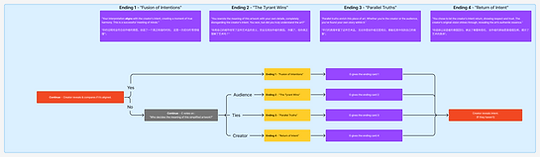
The Phase 3 vote branch from my flowchart, with the four ending cards above it.

First view


Second view
From The Beginner's Guide, through MDA
Mechanics: The Beginner's Guide is simple first-person exploration with almost no fail state. I kept a simple draw-and-guess format with no way to lose, so players focus on meaning rather than winning.
Dynamics: the game runs on tension between the narrator's reading of the creator's work and the creator's own intent. The Interpreter carries that role and can guide the room or mislead it, while the Creator stays silent until the reveal.
Aesthetics: doubt and curiosity. Each round ends by comparing the Audience's version with the Creator's complete drawing.
From gamey to not so gamey
The scoring version asked players to make their drawing as close as possible to the Creator's complete version. It rewarded competition, which worked against the question the game asks. Without a tangible goal, the game became a multi-ending scenario driven by the vote result.
Pace
I designed each session to last 8 to 10 minutes. Drawing, discussion and each Audience turn are timed, and the verbs are direct: speak became draw, and debate became vote.
Hints built to drift
Each hint card mixes options close to the Creator's theme with reversed ones, and never gives the answer. The Interpreter reads the drawing first and may guide the room or mislead it. Each Audience member then adds to the drawing in red, so the picture drifts toward a vote on who decides its meaning.
A Creator's simplified drawing in black, and an Audience version with red additions.
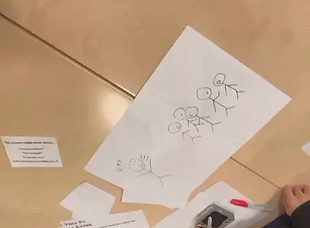
Creator's drawing
The Creator's simplified drawing, in black.
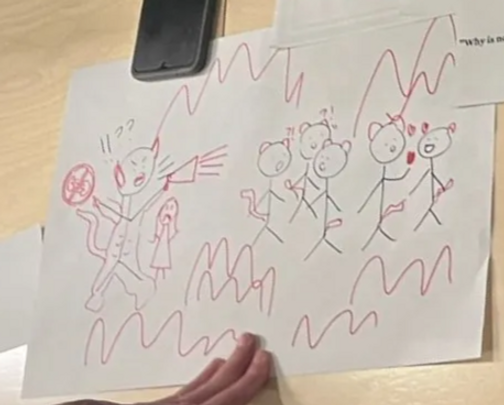
Audience version
An Audience version with red additions.

Phase 1: Create
The Creator picks an Inspiration Card and has 3 minutes to draw two versions: a Simplified one with minimal lines and symbols, and a Complete one that stays hidden. Meanwhile the Interpreter and the Audience receive the matching hint card and discuss for 3 minutes what the Creator might draw.
Phase 2: Interpret and recreate
The Creator shows only the simplified drawing, without explaining it. The Interpreter gives the first reading. Each Audience member then has 30 seconds to add details in red that show their own reading, with no discussion.
Phase 3: Reveal
The Interpreter reinterprets the changed drawing. Vote 1 asks: "Do you think B's explanation matches what the creator had in mind?" (B is the Interpreter.) Yes ends in Fusion of Intentions. No leads to Vote 2: "So, who gets to decide what this artwork really means?" Creator ends in Return of Intent, Audience in The Tyrant Wins, and a tie in Parallel Truths. A tie on Vote 1 goes straight to the reveal: if the drawings align, the round ends in Fusion of Intentions; if not, Vote 2 follows. The Creator then reveals the Complete version.
The cards I wrote
5 Inspiration Cards: Floating; Story of "🌱"; "Why is no one listening to me?"; Fracture; Confusion. Each has a hint card with 4 options, for example Floating: Sinking, Drifting, Falling, Rising. Plus 2 vote cards and 4 ending cards.
Materials
A timer, two sheets of paper for the Creator, black markers for the Creator, red markers for the Audience, and the printed cards.
What the class run showed
I ran the game in class, and everyone was interested and active, because every Audience member had to draw, not just talk. The Tyrant Wins landed as the most surprising ending. My next pass gives players a clearer intro to their Audience role and builds up the other three endings.
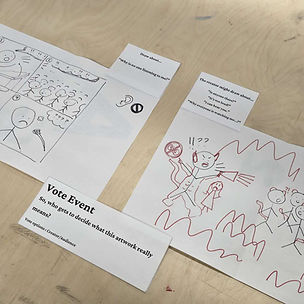
One finished round: the Creator's complete drawing, the Audience's red version and the Vote 2 card.
First view
Second view
What worked
The game carries a digital game's question into a physical format. In the in-class run everyone was active, because they had to draw something rather than only talk.
The Tyrant Wins was the most surprising of the four endings. That is the ending the hint cards and the Interpreter role were built to lead the room toward.
Keeping the question hidden
I presented the game as an ordinary draw-and-guess, so the real question stayed a surprise until the votes.
Next pass
A clearer intro so players know how to perform as the Audience while the question stays hidden, and more work on Fusion of Intentions, Parallel Truths and Return of Intent so each lands as strongly as The Tyrant Wins.